
Hi, I’m Alex Bellos.
I write and I talk. Usually about mathematics, puzzles, football or Brazil. My books – which have sold more than a million copies and been translated into more than 20 languages – include Alex’s Adventures in Numberland, Can You Solve My Problems?, Futebol: The Brazilian Way of Life and the children’s book series Football School. I also write a puzzle column in the Guardian, and present documentaries on BBC Radio 4. My YouTube videos have registered more than 30 million views, and I am the inventor of Loop, the elliptical pool game.
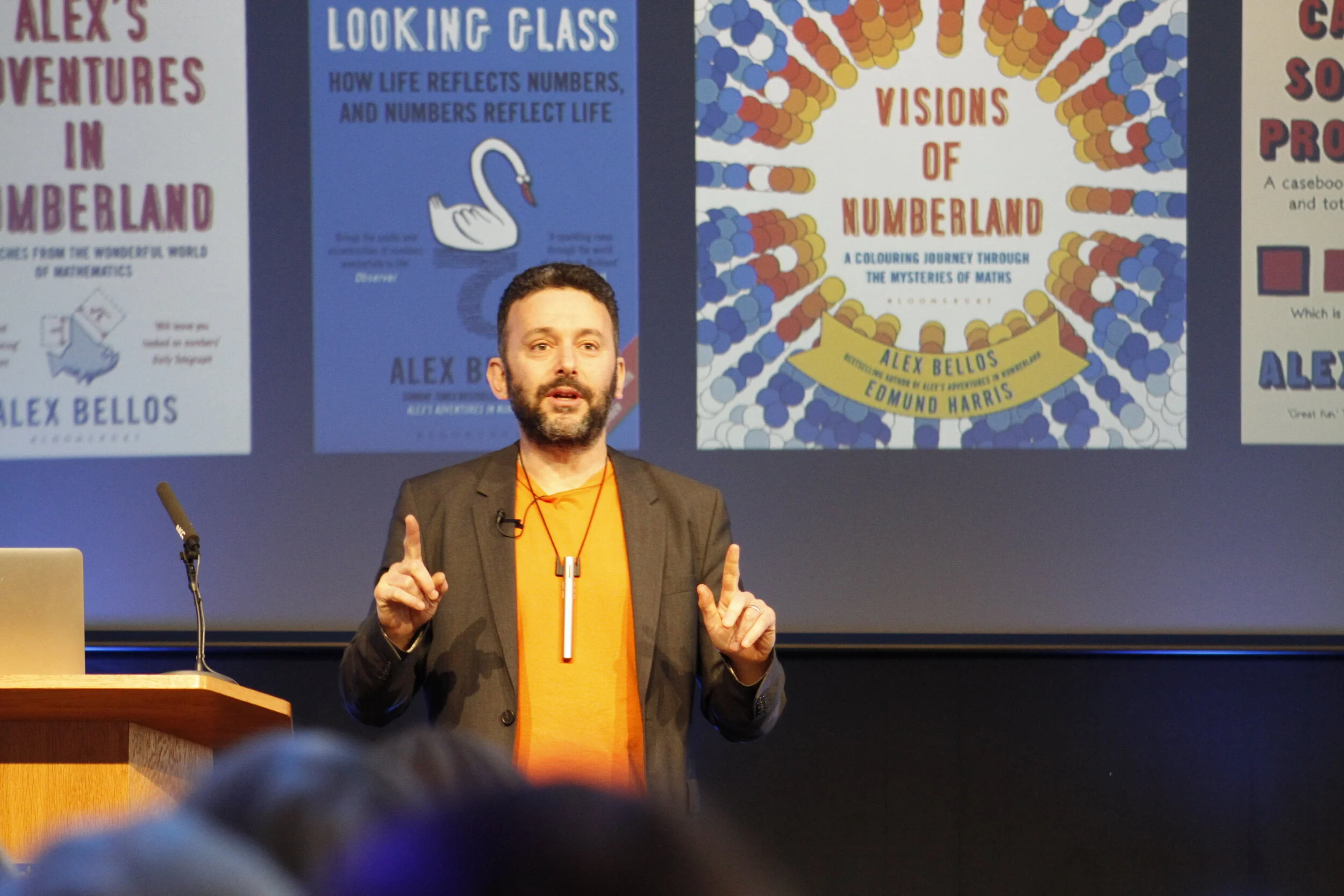
I am also an experienced public speaker. I give keynotes at educational conferences, speak at corporate events and visit many schools and colleges in the UK and beyond. If you would like me to come to your institution, please get in touch.
I give a number of free talks based around the Football School series every year to primary schools. Please ask me for more details.
From February to May 2024 I am the Science Communicator in Residence at the Simons Institute for the Theory of Computing, University of California, Berkeley.

PUZZLE book
My most recent adult book is the Language Lover’s Puzzle Book. It contains puzzles about language and languages, from Egyptian hieroglyphics to A.I. You will find enigmas about English, a riddle about Rarotonga, and a stumper about stenography, as well as dozens of other problems about exotic tongues and mysterious alphabets. If you like cracking codes, solving sudoku, completing crosswords or scrutinising Scrabble, there will be something in it for you. To find out more click here

KIDS BOOK
Football School is a book series aimed at children aged 7-13 that uses football to open up the curriculum, encourage curiosity and stimulate reading. The latest volume in the series is The Football School Encyclopedia.
“If your children like football, there’s only one book they need.” - The Daily Telegraph
public speaker
I give talks to all ages, professions and mathematical levels, from primary school pupils to CEOs, tech specialists and financial investors.